GP's Monthly Jukebox
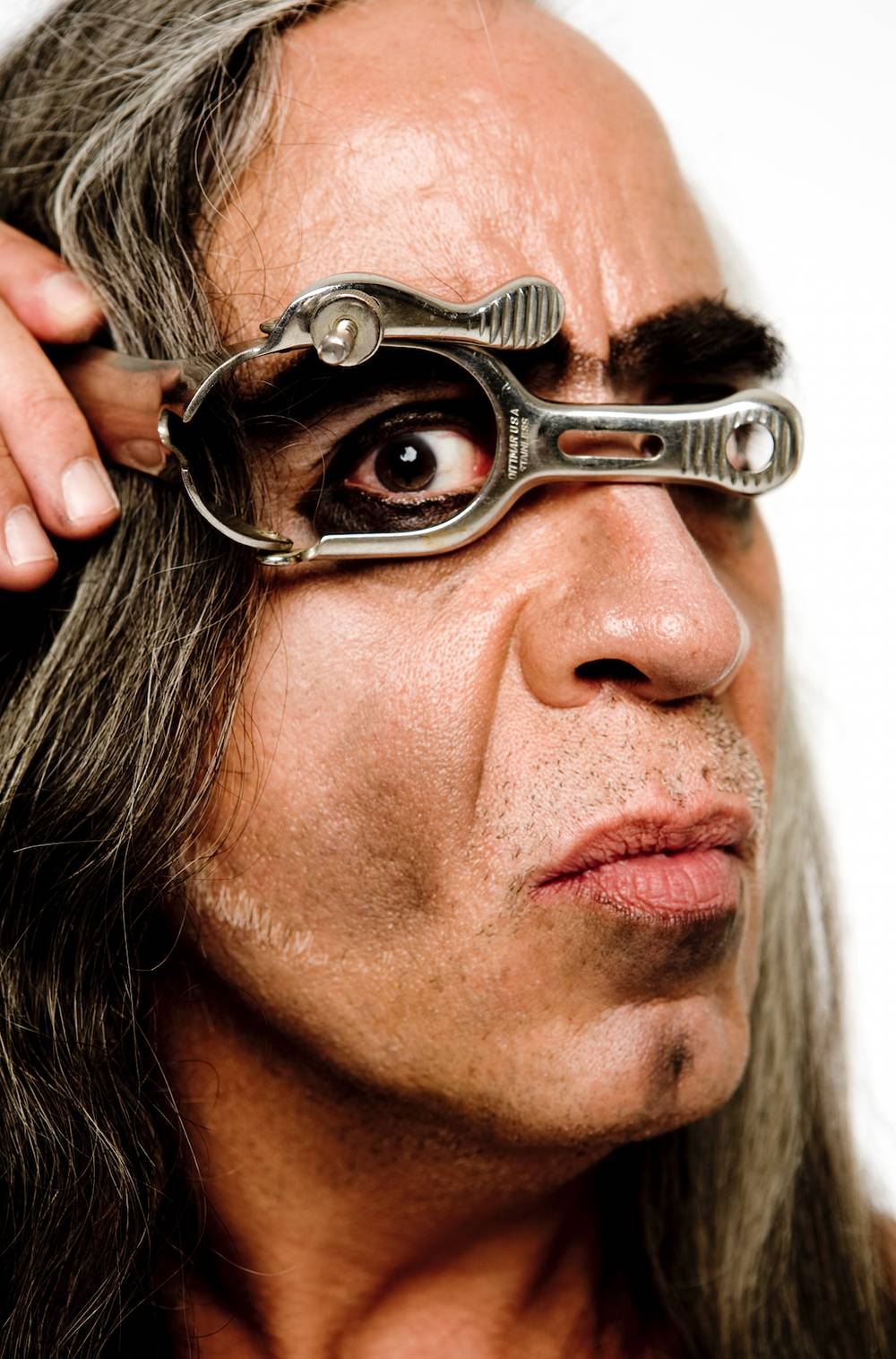
A curated space and rotating gallery of text, film and images personally selected by Gómez-Peña from his living archives. Please return regularly!
FILM OF THE MONTH:
Short documentation of La Pocha Nostra occupying Saint Joseph’s Art Society, 2024.
TEXTS OF THE MONTH: Two recent presenters wrote beautiful introductions for GGP that we share below.
Written by Tiffany Meesha Thompson
Founding Director of Petrichor Projects
We are gathered here tonight
as witnesses to an ending.
Western Civilization,
that vast architecture of power, myth, and conquest,
has reached its breaking point.
It is not fading.
It is collapsing.
And we are standing inside the collapse.
My name is Tiffany Thompson.
I am the founder of Petrichor Projects
and curator of the gallery at the Crossroads Hotel.
Tonight, we meet at a threshold:
a hotel devoted to artists
and to those who look directly at the fracture
and do not turn away.
There is a reason we meet at a crossroads.
Crossroads are sites of decision and transformation,
where the past concludes
and the future emerges.
We gather in that space.
This evening exists through collaboration:
JoAnne Northrop and the Nerman Museum of Contemporary Art;
the dedication of La Pocha Nostra,
with Artistic Co-Director Balitronica
and core member Indigo June among us;
the work of Elaine Buss,
whose exhibition in the gallery inspired this vision;
and through Philo and his art car,
Andrew, Jack, and Adriana at the Nerman Museum,
Dalton, Mikel, Danny,
and the Crossroads Hotel crew
who made this moment possible.
Please silence your phones.
No photography. No video.
The world order that shaped the last five centuries
is unraveling before our eyes.
Wars multiply.
The planet burns.
Democracy falters.
Authoritarianism spreads.
People are detained, shot, silenced in the streets.
Machines begin to think.
The system that once declared itself permanent
reveals its fragility,
its cruelty,
its end.
So what do we do at the end of a world?
We gather.
We witness.
We refuse isolation.
We stand together
between what was
and what might still be imagined.
For over four decades,
Guillermo Gómez-Peña,
one of the most consequential performance artists of our time,
has been preparing us for this moment.
He has lived in the borderlands
between nations,
between languages,
between identities that refuse containment.
Born in Mexico City,
he crossed into the United States in 1978.
Since then, his body has been a contested territory,
a site of ritual, resistance, and transformation.
His work dismantles borders:
not only those drawn on maps,
but those inscribed into culture,
memory,
and the body itself.
He is a MacArthur Fellow,
a Guggenheim Fellow,
a USA Artists Fellow,
recipient of the American Book Award,
author of more than twenty books,
and founder and artistic director of La Pocha Nostra,
a collective that has redefined performance
across continents and generations.
But none of that is why we are here.
We are here because he asks a question
that cannot be ignored:
What does it mean to remain human
in a post-human world?
Guillermo says that art offers one humble path.
Tonight, language becomes ritual.
The body becomes an altar.
The stage becomes a site of reckoning.
And so we turn to him.
Guillermo Gómez-Peña.
Vivian Zavataro Intro: Ulrich Museum, Wichita
It is truly an honor to introduce tonight’s speaker and performer, Guillermo Gómez-Peña.
For over 35 years, Gómez-Peña has occupied a vital and provocative position as both insider and outsider within the art world—simultaneously embedded in its structures and persistently challenging them. As a writer and performance artist, his work has relentlessly confronted, rewritten, and restaged so-called Western art history, exposing its colonial legacies and the systematic exclusion, demonization, and fetishization of Brown, Black, and Indigenous bodies.
Today, Gómez-Peña arrives “unplugged, ”speaking directly back to the art world with urgency and clarity. His practice has long interrogated mainstream cultural institutions and their pervasive complicity with white supremacy. Tonight’s keynote, An Open Letter to the Museum of the Future, is both a critique and a call to action: a demand for open dialogue, for radical restructuring from within, and for a collective response from all cultural workers—curators, artists, activists, educators, and all those invested in imagining a more just and inclusive art world.
On a personal note, when I began my journey with the Ulrich Co-Lab, a conversation with Guillermo over dinner in Portland profoundly reshaped my approach to curation. That exchange continues to resonate in the work we are doing here today.
This project and exhibition we find ourselves surrounded by, in many ways, is an omen, a glimpse of the museum of the future. A space where inclusion is not symbolic but structural; where everyone is present not only in the galleries, but on the walls, in the narratives, and in the shaping of meaning itself. A decolonized, radical space where we speak openly, connect deeply, and build together. A museum that is not confined by its walls, but is nimble and expansive, reaching into historically and systemically excluded communities and inviting meaningful, sustained dialogue.
It is in this spirit that we welcome Guillermo tonight.